Propane systems offer incredible utility for off-grid operations. They also demand rigorous respect for safety protocols. Discovering an issue at the primary connection point can disrupt your daily operations quickly. You must act fast to prevent dangerous gas accumulation. A Leaking POL Valve is not just a regulatory compliance failure. It presents immediate safety hazards, accelerates gas loss, and causes operational downtime for commercial, RV, or marine applications. Misdiagnosing the source of a leak at the cylinder connection often leads to unnecessary equipment replacement. Conversely, it can result in highly dangerous DIY workarounds. We designed this guide to provide an evidence-based, industry-standard diagnostic framework. We will help you definitively locate leaks and assess valve integrity. You will finally understand exactly when a hardware upgrade becomes mandatory to protect your equipment.
Key Takeaways
Always prioritize immediate site safety—isolate the gas supply and ventilate the area before beginning any diagnostic procedure.
The industry-standard "soapy water test" remains the most reliable, verifiable method for pinpointing microporosity or seal failures in an LPG cylinder valve.
Distinguish between a regulator connection issue (often solvable via O-ring replacement) and an internal valve stem failure (requiring complete cylinder valve replacement).
Upgrading to high-compliance hardware, such as the V9 POL Valve or V9S3 POL Valve, minimizes long-term failure rates in high-vibration (RV/marine) and commercial environments.
Immediate Safety Protocols: Securing the Environment Before Diagnosis
Diagnosing a faulty connection must not occur in an active threat environment. Establish clear safety parameters before initiating any physical testing. Gas leaks introduce severe flammability risks. You must treat every suspected leak as a critical hazard until proven otherwise.
Isolate the Cylinder
You should immediately close the handwheel to shut off the gas supply. Turn the knob clockwise until it seats firmly. Do not over-tighten, as excessive force can damage internal rubber seals. Disconnect any active ignition sources nearby. Unplug electrical devices. Extinguish pilot lights. Ensure no personnel operate machinery in the immediate vicinity.
Ventilation Verification
Ensure the surrounding area is well-ventilated. Liquid petroleum gas is heavier than air. It pools in low-lying areas. In enclosed spaces like RV compartments or marine holds, natural airflow often proves insufficient. Utilize mechanical, non-sparking ventilation to disperse trapped gas. Open all access doors and hatches to dilute the concentration.
Risk Assessment
Evaluate the immediate atmosphere. If the distinct smell of mercaptan is overpowering, evacuate the area immediately. Similarly, a loud hissing audible after you fully close the valve demands evacuation. These signs indicate a catastrophic internal failure rather than a minor connection leak. Do not attempt diagnosis under these conditions. Contact local emergency responders or your gas supplier.
Common Indicators of a Leaking POL Valve
Recognizing the initial warning signs prompts a formal diagnosis. A POL Valve gives off specific sensory clues when it fails. We rely on standard observational methods to catch these issues early.
Sensory Evaluation
Olfactory: The presence of ethyl mercaptan provides the most common alert. Manufacturers add this "rotten egg" scent to naturally odorless propane. A lingering smell near the tank always warrants investigation.
Auditory: Listen for hissing sounds near the top outlet. You might also hear faint whistling around the regulator connection. Sound intensity typically increases when you open the main cylinder knob.
Visual (Thermal): Watch for frosting or condensation. Localized freezing around the brass body of the LPG Cylinder Valve indicates rapid, uncontrolled gas expansion. This cooling phenomenon happens because the expanding gas absorbs heat from the surrounding metal.
Performance Metrics
Monitor your system gauges. Unexplained pressure drops on inline gauges often suggest a slow leak. You might also notice faster-than-expected cylinder depletion. If your standard gas usage suddenly requires more frequent refills, suspect a hardware breach.
Table: Common Leak Indicators and Severity Levels
Indicator Type
Observable Sign
Severity Level
Immediate Action Required
Olfactory
Faint mercaptan odor near the connection
Moderate
Isolate cylinder and prepare for testing.
Auditory
Loud, persistent hissing sound
High
Shut off gas, extinguish flames, ventilate area.
Visual
Heavy frost accumulation on brass fittings
Critical
Evacuate area and contact a professional.
Performance
Rapid pressure drop on gauge over 24 hours
Low to Moderate
Perform routine diagnostic testing.
The 3-Step Diagnostic Framework (The Soapy Water Test)
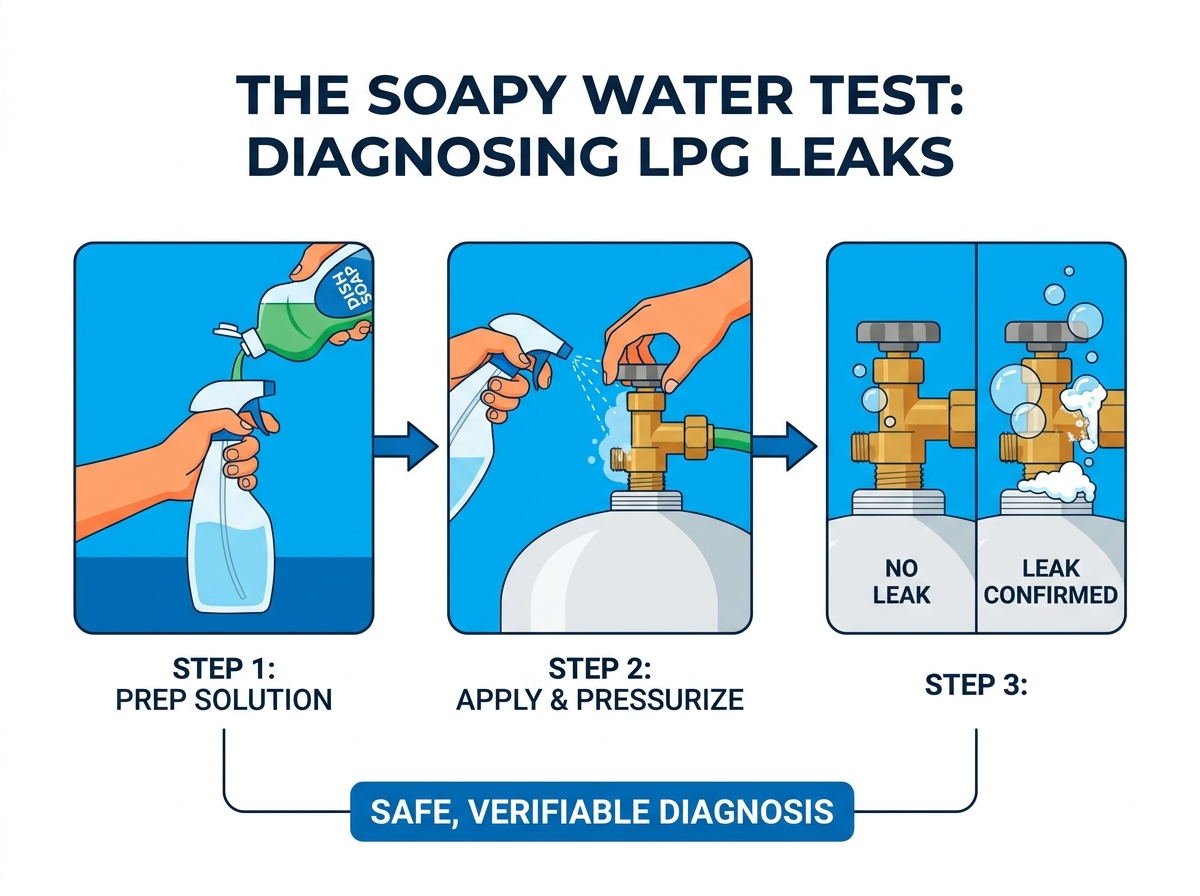
The industry-standard soapy water test remains the safest diagnostic methodology. Open-flame testing is extremely dangerous and strictly prohibited by global safety standards. Follow these precise steps to evaluate your system.
Step 1: Preparation
Mix a standard solution of liquid dish soap and water. Use a one-to-three ratio for a thick, bubbly consistency. Avoid ammonia-based glass cleaners entirely. Ammonia causes stress corrosion cracking in brass fittings over time. This chemical degradation silently weakens the forged body, leading to future ruptures. Place the soapy mixture in a clean spray bottle or use a small sponge.
Step 2: The 10-Second Application
Apply the solution generously over the entire assembly. Coat the fully connected valve body. Spray the regulator connection thoroughly. Cover the handwheel stem and the pressure relief valve (PRV). Once coated, slowly open the handwheel to pressurize the system. Wait approximately ten seconds to allow internal pressure to push through any micro-fractures.
Step 3: Evaluating the Evidence
Observe the coated surfaces carefully. You will see one of two reactions:
Static Bubbles: If you see small, stationary bubbles, this is normal application residue. No leak exists at this location.
Growing/Expanding Bubbles: If bubbles continuously grow or cluster, this confirms a live leak. Note the exact origin point. Pinpointing the origin isolates the faulty component for targeted repair.
Best Practices for Testing
Test connections after every refill or cylinder swap.
Reapply the solution if the wind dries the initial coat too quickly.
Perform tests in well-lit conditions to spot micro-bubbles.
Common Mistakes to Avoid
Using harsh industrial detergents containing corrosive chemicals.
Failing to test the PRV port on the back of the assembly.
Rushing the visual inspection before pressure fully stabilizes.
Root Cause Analysis: Where and Why LPG Cylinder Valves Fail
Breaking down specific failure points helps determine the correct fix. Once you pinpoint the leak location, you must understand why it happened.
The Bullnose/Regulator Connection
Leaks frequently occur at the connection point between the cylinder and the regulator. Modern soft-nose connections rely on a rubber O-ring to create a seal. Worn, missing, or deformed O-rings fail to hold pressure. Cross-threading from improper installation also causes significant leakage. If you force the threads during connection, you damage the brass, permanently compromising the seal.
The Valve Stem/Packing Gland
Leaks appearing directly under the handwheel indicate worn internal packing. The packing gland seals the rotating stem against high internal pressure. Over time, frequent opening and closing degrade this internal material. Over-tightening the knob accelerates this wear. Once the packing fails, gas escapes upward along the stem shaft.
Environmental Degradation
Operating environments heavily influence hardware longevity. High-vibration environments like RV chassis and marine transport accelerate thread degradation. Constant road shock loosens mechanical seals. Furthermore, exposure to salt air promotes galvanic corrosion. Salinity creates pitting on brass surfaces, preventing O-rings from seating flush against the metal.
Repair vs. Replace: Evaluating Your Corrective Options
Translating diagnostic findings into safe action is your final step. You must decide whether a simple component fix suffices or a complete system replacement is necessary.
When to Repair (Component Level)
Sometimes, the fix is straightforward. If the leak remains strictly isolated to the regulator connection, inspect the threads. If the brass threads look pristine, you can likely repair the connection. Replacing the soft-nose O-ring often resolves the issue. Ensuring proper torque during reattachment also stops minor leaks. Clean the connection thoroughly to remove debris before installing a new O-ring.
When to Replace (System Level)
You must replace the entire unit if the leak originates from the main body or the PRV. Internal stem leaks also require full replacement. Do not attempt to repack internal glands yourself. If you observe physical burring, deep scratches, or heavy wear on the threads, the unit is compromised. Operating a damaged cylinder invites catastrophic failure.
Shortlisting High-Reliability Upgrades
When replacement becomes mandatory, select robust hardware designed for modern safety mandates. Upgrading prevents recurring failures and improves operational safety.
V9 POL Valve: This model is ideal for standardizing commercial fleets. It works perfectly for upgrading legacy cylinders. It focuses on robust sealing technology and superior anti-corrosion properties.
V9S3 POL Valve: Evaluate this option for heavy-duty applications. It delivers advanced safety features and superior thread durability. It guarantees strict compliance with modern global gas safety mandates.
Success Criteria for New Hardware
Always select replacement hardware based on forged brass quality. Ensure the unit features certified safety relief mechanisms. Verify that the manufacturer offers long-term warranty support. High-quality forgings resist stress corrosion and handle mechanical shock much better than cheap alternatives.
Table: Repair vs. Replace Decision Matrix
Leak Location
Observed Condition
Recommended Action
Regulator Connection
Damaged O-ring, threads intact
Repair (Replace O-ring)
Regulator Connection
Cross-threaded or burred brass
Replace Entire Valve
Under Handwheel (Stem)
Expanding bubbles present
Replace Entire Valve
Pressure Relief Valve
Hissing or bubbling from PRV port
Replace Entire Valve
Main Brass Body
Visible cracks or corrosion weeping
Replace Entire Valve
Conclusion
Accurate diagnosis relies on systematic observation and the soapy water test. This approach effectively removes guesswork from gas safety.
Always prioritize ventilation and isolation before you conduct diagnostic evaluations.
Never attempt to dismantle or re-pack an internal cylinder mechanism yourself.
If the brass body or internal seals fail, contact your gas supplier to safely decant the cylinder.
Specify certified, high-grade replacements to prevent recurring failures and secure your equipment.
FAQ
Q: Can I use a sealant tape (Teflon) on a leaking POL valve?
A: No. Standard POL fittings are designed to seal mechanically (brass-to-brass or via a soft-nose O-ring). Applying standard PTFE tape can interfere with the connection, create false seals, and introduce debris into the regulator.
Q: Why does my LPG cylinder only leak when the regulator is attached?
A: This typically points to a damaged O-ring on the male fitting of the regulator. It may also indicate an incompatible top outlet connection or a worn interior thread on the cylinder itself.
Q: What should I do if my RV gas cylinder leaks during travel?
A: Shut off the main cylinder handwheel immediately. Ventilate the propane locker thoroughly. Perform a soapy water test upon arriving at a safe location. High vibrations often loosen fittings; consider upgrading to commercial-grade components designed for transit durability.
Q: What is the expected lifespan of a standard LPG cylinder valve?
A: While cylinders undergo requalification (typically every 10 years depending on local regulations), you should inspect connections annually. Immediately replace the unit if you detect thread wear, handwheel stiffness, or micro-leaks.
Room 803, Building 1, Qianjiang Shenlan International Center, Yingfeng Street, Xiaoshan District, Hangzhou, Zhejiang 311200, China (Zip Code: 311200)

 Hot Line:+86 571 8768 0216